

How To Comput And Draw The Fourir Transformation In Matlab
Fundamental focus : Learn how to plot FFT of sine wave and cosine wave using Matlab. Understand FFTshift. Plot 1-sided, double-sided and normalized spectrum.
Introduction
Numerous texts are available to explain the basics of Discrete Fourier Transform and its very efficient implementation – Fast Fourier Transform (FFT). Oft we are confronted with the need to generate simple, standard signals (sine, cosine, Gaussian pulse, squarewave, isolated rectangular pulse, exponential disuse, chirp signal) for simulation purpose. I intend to bear witness (in a series of articles) how these basic signals can be generated in Matlab and how to correspond them in frequency domain using FFT. If you are inclined towards Python programming, visit here.
Sine Wave
In order to generate a sine wave in Matlab, the first step is to fix the frequency 



f=x; %frequency of sine wave overSampRate=30; %oversampling charge per unit fs=overSampRate*f; %sampling frequency stage = 1/3*pi; %desired stage shift in radians nCyl = 5; %to generate five cycles of sine wave t=0:i/fs:nCyl*1/f; %time base 10=sin(2*pi*f*t+phase); %replace with cos if a cosine wave is desired plot(t,x); title(['Sine Wave f=', num2str(f), 'Hz']); xlabel('Time(s)'); ylabel('Amplitude'); 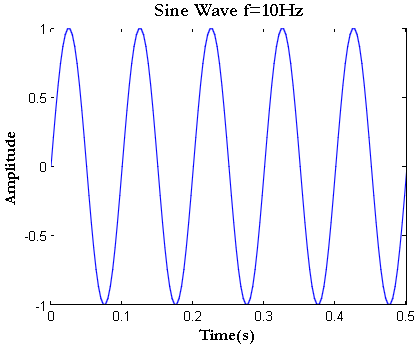
Representing in Frequency Domain
Representing the given signal in frequency domain is done via Fast Fourier Transform (FFT) which implements Detached Fourier Transform (DFT) in an efficient mode. Commonly, power spectrum is desired for analysis in frequency domain. In a power spectrum, power of each frequency component of the given signal is plotted against their respective frequency. The command 


Unlike representations of FFT:
Since FFT is only a numeric ciphering of
i. Plotting raw values of DFT:
The x-centrality runs from 


NFFT=1024; %NFFT-point DFT X=fft(x,NFFT); %compute DFT using FFT nVals=0:NFFT-1; %DFT Sample points plot(nVals,abs(X)); title('Double Sided FFT - without FFTShift'); xlabel('Sample points (N-point DFT)') ylabel('DFT Values'); 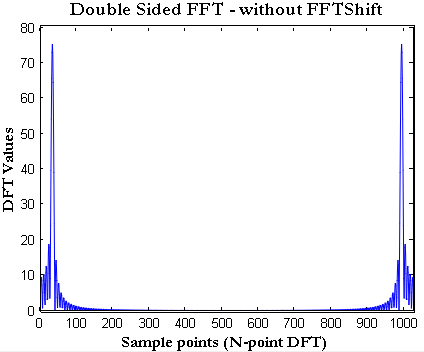
2. FFT plot – plotting raw values against Normalized Frequency centrality:
In the next version of plot, the frequency axis (10-axis) is normalized to unity. But divide the sample index on the ten-axis by the length 
NFFT=1024; %NFFT-point DFT X=fft(10,NFFT); %compute DFT using FFT nVals=(0:NFFT-one)/NFFT; %Normalized DFT Sample points plot(nVals,abs(X)); title('Double Sided FFT - without FFTShift'); xlabel('Normalized Frequency') ylabel('DFT Values'); 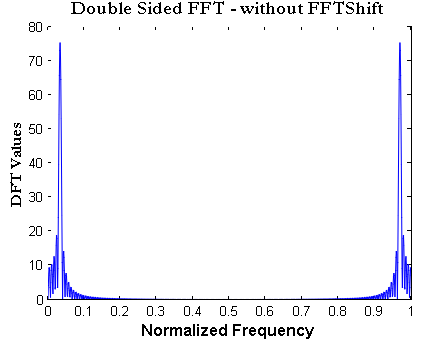
iii. FFT plot – plotting raw values confronting normalized frequency (positive & negative frequencies):
As you lot know, in the frequency domain, the values take upwardly both positive and negative frequency axis. In order to plot the DFT values on a frequency axis with both positive and negative values, the DFT value at sample alphabetize 


NFFT=1024; %NFFT-bespeak DFT X=fftshift(fft(x,NFFT)); %compute DFT using FFT fVals=(-NFFT/two:NFFT/2-1)/NFFT; %DFT Sample points plot(fVals,abs(X)); championship('Double Sided FFT - with FFTShift'); xlabel('Normalized Frequency') ylabel('DFT Values'); 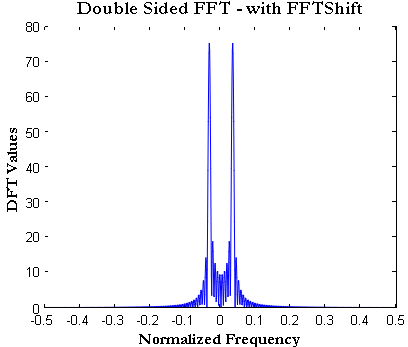
4. FFT plot – Absolute frequency on the x-axis Vs Magnitude on Y-axis:
Here, the normalized frequency axis is just multiplied by the sampling charge per unit. From the plot below we can ascertain that the accented value of FFT peaks at 


NFFT=1024; X=fftshift(fft(x,NFFT)); fVals=fs*(-NFFT/2:NFFT/2-1)/NFFT; plot(fVals,abs(10),'b'); title('Double Sided FFT - with FFTShift'); xlabel('Frequency (Hz)') ylabel('|DFT Values|'); 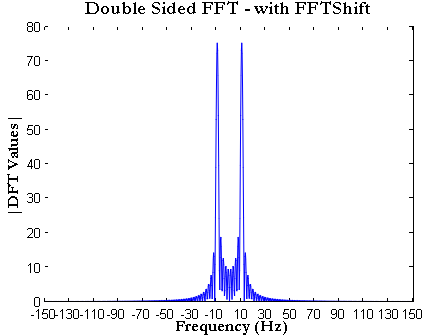
five. Power Spectrum – Absolute frequency on the x-axis Vs Power on Y-axis:
The following is the most important representation of FFT. It plots the ability of each frequency component on the y-centrality and the frequency on the x-axis. The power can be plotted in linear scale or in log scale. The power of each frequency component is calculated as

Where 

NFFT=1024; Fifty=length(10); X=fftshift(fft(ten,NFFT)); Px=X.*conj(X)/(NFFT*L); %Ability of each freq components fVals=fs*(-NFFT/2:NFFT/2-1)/NFFT; plot(fVals,Px,'b'); title('Power Spectral Density'); xlabel('Frequency (Hz)') ylabel('Power'); 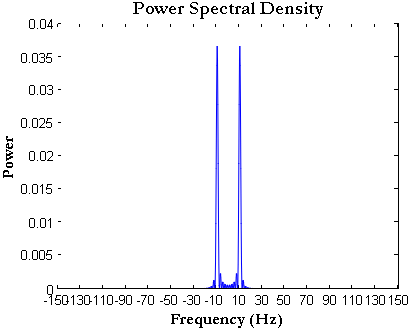
If you wish to verify the total power of the signal from time domain and frequency domain plots, follow this link.
Plotting the power spectral density (PSD) plot with y-centrality on log scale, produces the almost encountered type of PSD plot in signal processing.
NFFT=1024; L=length(x); Ten=fftshift(fft(x,NFFT)); Px=10.*conj(X)/(NFFT*Fifty); %Power of each freq components fVals=fs*(-NFFT/2:NFFT/2-one)/NFFT; plot(fVals,x*log10(Px),'b'); title('Power Spectral Density'); xlabel('Frequency (Hz)') ylabel('Power'); 6. Ability Spectrum – One-Sided frequencies
In this type of plot, the negative frequency part of ten-axis is omitted. Merely the FFT values corresponding to 

Fifty=length(x); NFFT=1024; X=fft(ten,NFFT); Px=X.*conj(X)/(NFFT*L); %Power of each freq components fVals=fs*(0:NFFT/ii-1)/NFFT; plot(fVals,Px(ane:NFFT/2),'b','LineSmoothing','on','LineWidth',ane); title('One Sided Ability Spectral Density'); xlabel('Frequency (Hz)') ylabel('PSD'); 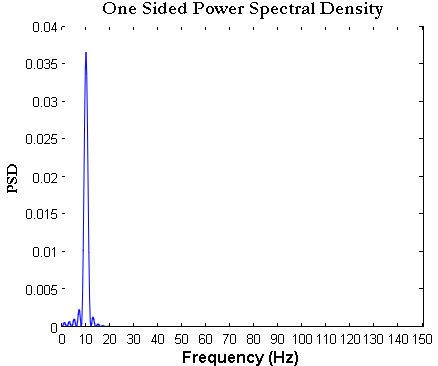
Charge per unit this article: 
 (112 votes, average: iv.66 out of 5)
For further reading
[1] Power spectral density – MIT opencourse ware↗
Topics in this affiliate
Books past the author

Source: https://www.gaussianwaves.com/2014/07/how-to-plot-fft-using-matlab-fft-of-basic-signals-sine-and-cosine-waves/
Posted by: saltzimen1990.blogspot.com
0 Response to "How To Comput And Draw The Fourir Transformation In Matlab"
Post a Comment